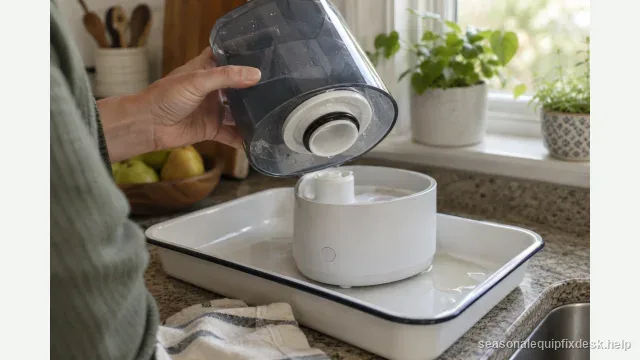
Quick answer: A humidifier that mists or evaporates normally but never raises the room's measured humidity is usually a sizing or measurement problem. There are three common causes. The unit may be too small for the space, the hygrometer reading may not be trustworthy, or moisture may be escaping the room as fast as the humidifier adds it. Work through those three before assuming the humidifier itself needs service.
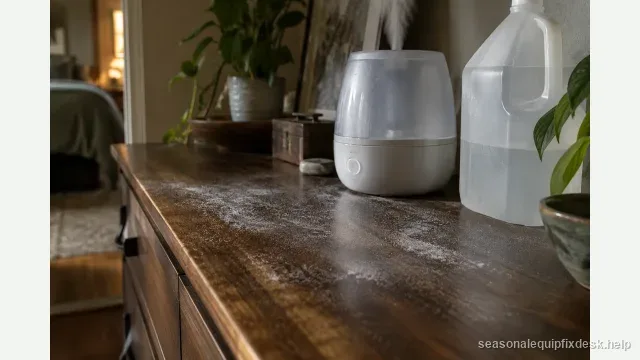
White dust can be a water-mineral clue even when output seems normal; use the controlled water comparison to separate it from weak room humidity. See the white mineral dust from an ultrasonic humidifier guide for the matching checks.
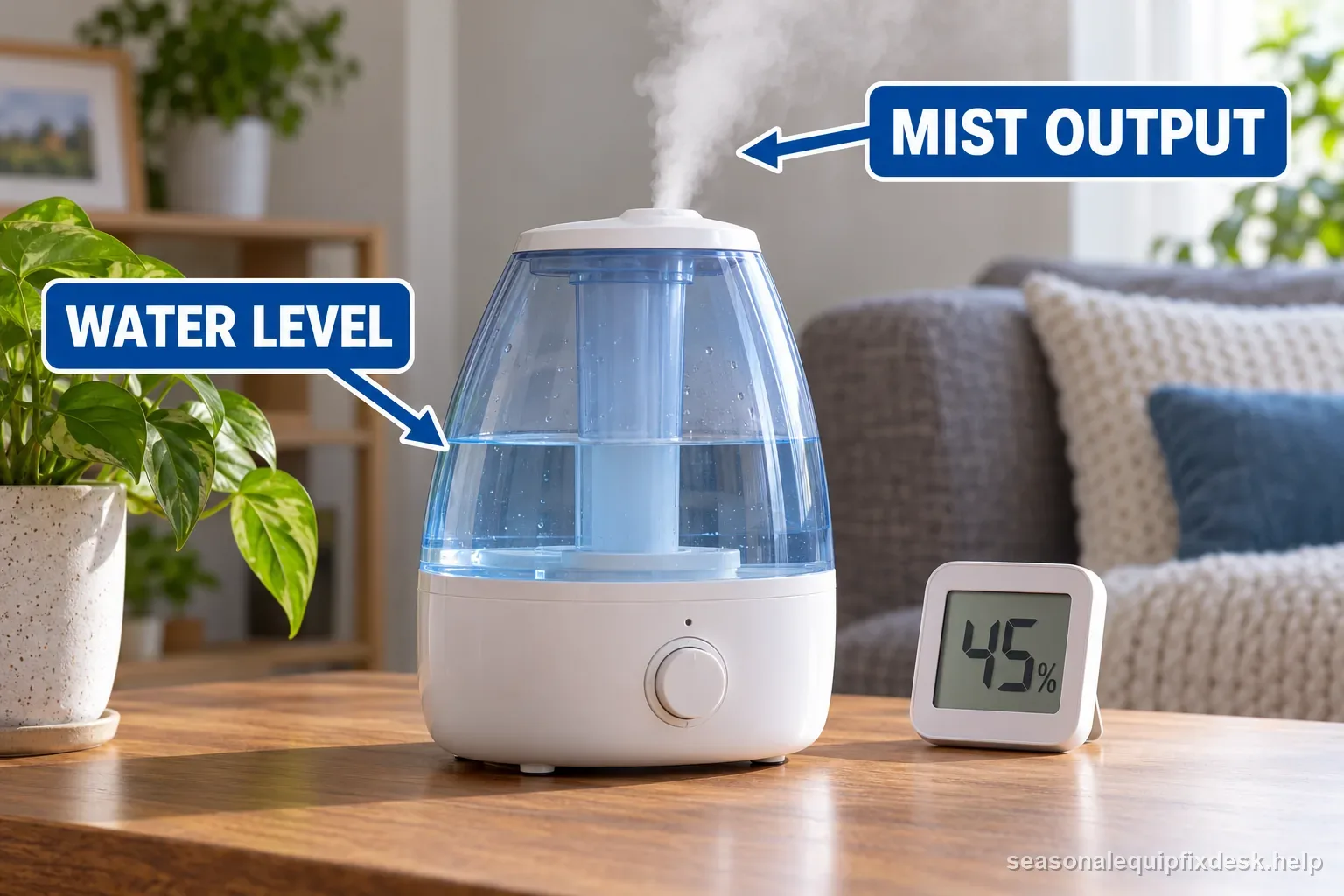
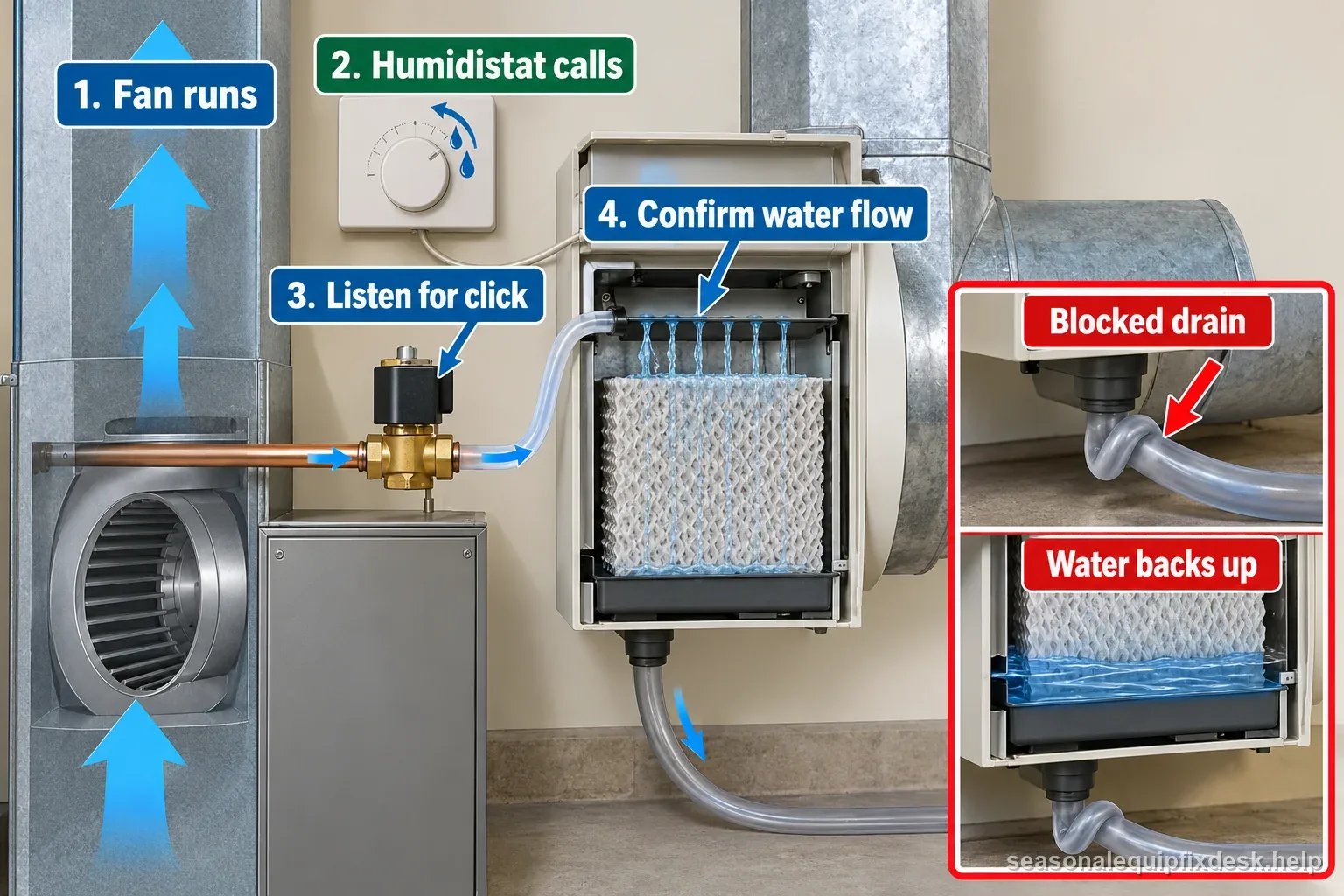
| Observation | Most likely explanation | Next step |
|---|---|---|
| Water level does not fall or mist is absent | Output or water-path issue | Clean and refill only as the manual permits; check the indicator |
| Output is steady but reading stays flat | Room too large, air exchange, or meter placement | Close doors/windows and compare with a second hygrometer |
| Whole-house unit runs only with furnace | Limited operating hours or control demand | Check settings and filter/panel; leave wiring and water valve service to a technician |
Check the humidifier's rated coverage against the actual room
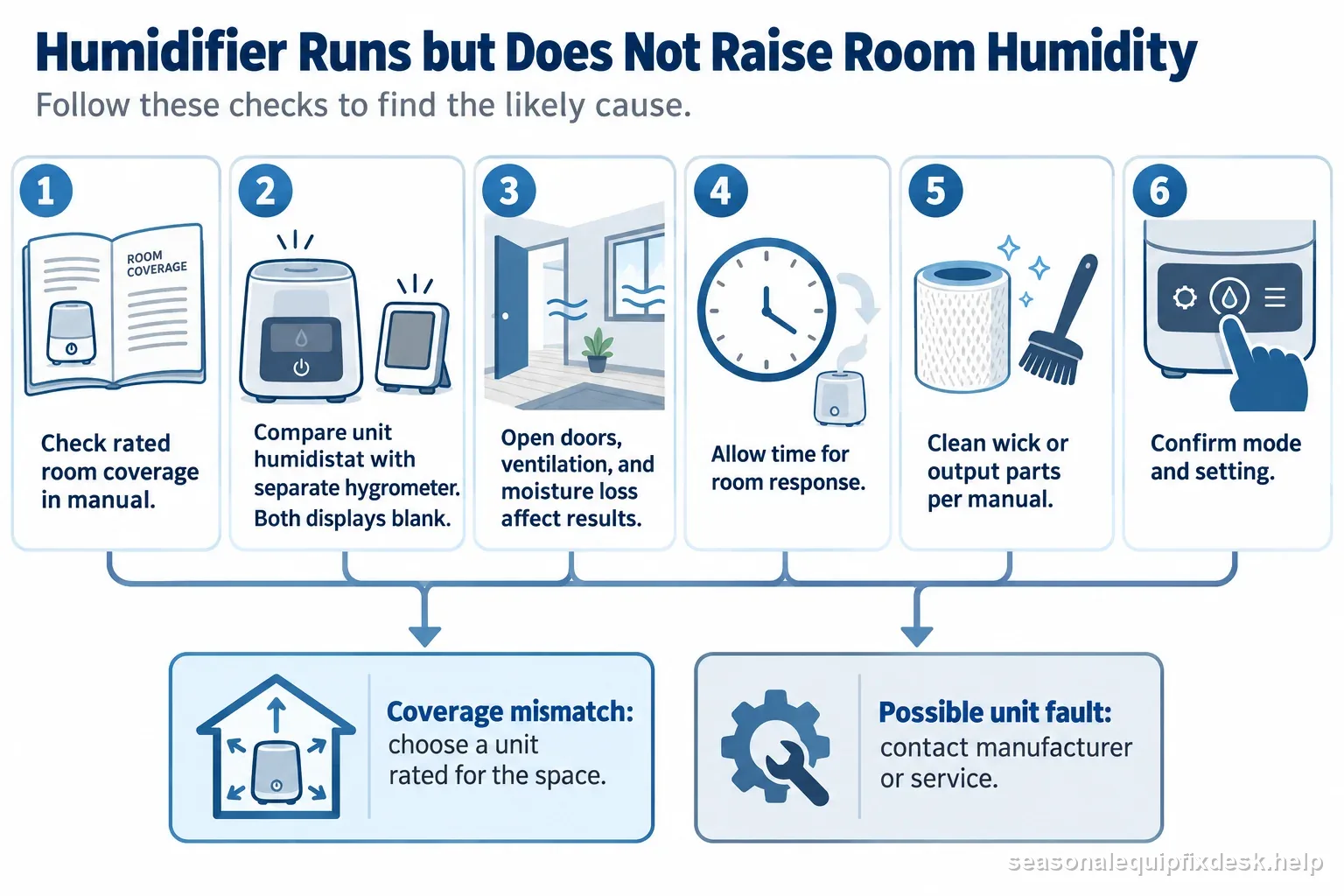
Every humidifier is rated for a maximum square footage. That number assumes something close to ideal conditions: a closed room, average ceiling height, and no unusual air exchange. A small tabletop unit rated for a bedroom will make almost no measurable difference in an open-concept living and kitchen space. That is true even running continuously at its highest setting, because it cannot produce enough total moisture for that much air. Compare the unit's stated coverage area on its box or manual against a rough measurement of the space it runs in. Include any adjoining rooms that share open airflow with it. Run two smaller units, or replace a bedroom-sized unit with one rated for the larger space. That is often the real fix when a unit that has always worked fine in a small room is now expected to cover a much bigger one.
Confirm your hygrometer is reading correctly
A surprising share of "humidity won't rise" complaints trace back to the measuring device. Cheap hygrometers can be off by ten percentage points or more out of the box. Try a basic salt test. Seal the hygrometer in a bag with a small dish of table salt dampened with a few drops of water for eight to twelve hours. It should settle to a reading very close to 75%. A hygrometer that reads meaningfully different from that after settling is not reliable and should not be trusted to judge whether the humidifier is working. Placement matters too. A hygrometer sitting a foot from the humidifier's mist outlet reads the cloud around the unit instead of the room's real average, so it will always look better than the air across the room. Move it three to five feet away from the unit, away from direct sun, exterior walls, and heating vents, for a more representative reading.
Look for where the moisture is going
A humidifier adds moisture, but doors, windows, exhaust fans, and even a furnace's fresh-air intake can remove it just as fast. A bathroom exhaust fan or kitchen range hood left running works against your humidifier. So does a door propped open to a hallway or another dry room, or a window cracked for fresh air. In a newer or larger home, central heating pulling in outside air can dilute a single room humidifier's output before it ever reaches equilibrium. Running the humidifier with the target room's door closed, and checking that no exhaust fan is quietly running nearby, rules out this cause quickly.
Give it time, especially in a newly dry space
Materials in a room (wood furniture, drywall, flooring, even books) absorb moisture from the air like a sponge when they start out very dry. That is especially true early in the heating season, when a furnace has been running for the first time in months. A humidifier turned on for the first time in a very dry room can run for several days before the room's measured humidity starts climbing. The room's contents are absorbing moisture faster than the air can hold it. If your humidifier seems to make no progress on day one or two in a very dry room, give it a few more days before you treat it as a fault.
| What you observe | Likely branch | Next check |
|---|---|---|
| Humidistat and separate hygrometer differ | Sensor or placement mismatch | Compare them in the same room away from direct moisture |
| Large/open room or strong ventilation | Coverage or moisture-loss mismatch | Compare room conditions with the model’s rated coverage |
| Output parts are scaled or dirty | Reduced moisture delivery | Clean or replace parts only as the manual directs |
| Setup is correct but no room change occurs | Possible unit fault | Contact the manufacturer or qualified service |
Clean the parts that produce output
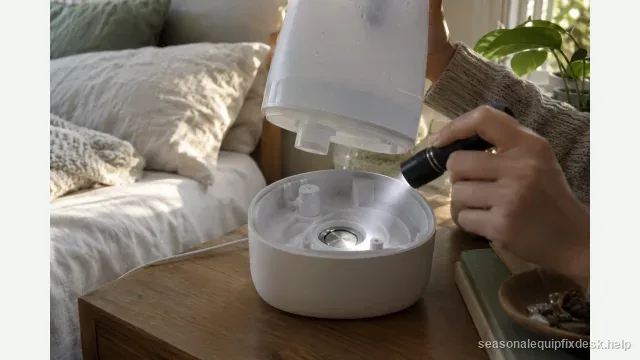
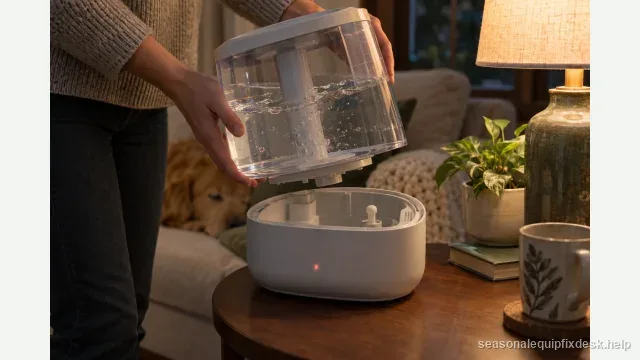
An evaporative humidifier's wick or filter, or an ultrasonic model's water reservoir and transducer plate, can accumulate mineral scale from hard water over time. Scale reduces how much moisture the unit can put into the air, even though it still sounds and looks like it is running normally. A wick that has gone stiff, crusted white, or visibly discolored is past the point of just needing a rinse and should be replaced per the manufacturer's schedule. Using distilled or demineralized water instead of straight tap water slows this buildup considerably and is worth the extra step in hard-water areas.
Confirm the output setting and mode
Many humidifiers default to an automatic or eco mode that deliberately limits output once it estimates a target humidity has been reached. That estimate is based on the unit's own onboard sensor. It can be just as inaccurate as a cheap standalone hygrometer, for the same placement and calibration reasons described above. Check that the unit is set to its intended output level. A low or automatic setting may be capping it early, based on a sensor reading you have not independently verified.
Putting the checks in a sensible order
- Compare the humidifier's rated square footage to the actual room, including any open adjoining space.
- Test your hygrometer with a salt-test calibration check, and move it three to five feet from the unit.
- Close doors and check for a running exhaust fan or an open window pulling moisture out of the room.
- If the room started very dry, give it several days of continuous running before judging results.
- Inspect and clean or replace the wick, filter, or reservoir if there is visible mineral scale.
- Confirm the unit is set to a real output level instead of an automatic mode capping it early.
A humidifier can operate without visible mist or measurable room change. Identify the design and symptom before replacing a cartridge or treating an indicator as a universal code.
When a bigger unit is genuinely the answer
Suppose every item above checks out: correct room size for a second opinion, a verified accurate hygrometer placed well away from the unit, doors closed, several days elapsed, and clean internal parts. If the room still will not move toward a healthy indoor range, the honest conclusion is usually that the unit is undersized for the space instead of faulty. A larger single unit, or a second unit placed in a different part of an open floor plan, addresses that directly. Continuing to run an undersized humidifier at maximum output around the clock mainly adds wear and higher mineral buildup without ever closing the gap.
A note on how much humidity is the target
Most winter indoor-comfort guidance points toward roughly 30% to 50% relative humidity. Chasing a much higher number, especially in a cold climate, can push moisture into exterior walls and windows and cause condensation problems that are worse than dry air. If a hygrometer reading in the high 20s or low 30s feels disappointing after all of the checks above, it may already be a reasonable and safe target. It does not mean anything is still wrong.
First confirm the humidifier is producing output; the no-mist troubleshooting steps distinguish a normal evaporative plume from a true output fault.